The electric bike market has exploded. In 2024, more than 1 million e-bikes were sold in the United States alone, and projections for 2025 and beyond suggest that number is only climbing. But here's the uncomfortable truth that no retailer is going to put on their homepage: a staggering number of those buyers made at least one expensive, frustrating, and entirely avoidable mistake before they ever took their first ride.
This isn't a beginner's problem or an expert's problem. It's a market problem. The e-bike industry grew faster than the consumer education around it. Specs sheets are deliberately confusing. Marketing language is slippery. And the difference between a bike that changes your life and one that collects dust in a garage can come down to a single misunderstood number on a spec sheet.
So let's fix that. This is the definitive guide to every major mistake e-bike buyers make — and exactly how to sidestep each one.
Mistake #1 — Chasing the Highest Wattage Number
Walk into any conversation about e-bikes and within five minutes, someone will bring up wattage. "I got a 750W motor." "Mine is 1000W." "There's one on Amazon with 1500W." It sounds logical — more watts, more power, better bike. Except that's not really how motors work, and treating wattage like a headline spec is one of the most common and costly mistakes a buyer can make.
The Wattage Myth, Explained
Motor wattage ratings are notoriously inconsistent across manufacturers. A "750W" motor from one brand may be rated at continuous output, while a "500W" motor from a premium brand is rated at continuous output but can peak at 900W when you need it. The peak vs. continuous distinction is rarely clarified on product pages, and it matters enormously for real-world performance.
What actually determines how a motor feels to ride is torque, measured in Newton-meters (Nm). Torque is the rotational force that gets you up a hill, accelerates you from a stop, or hauls cargo. A motor with 80Nm of torque will feel dramatically more powerful on an incline than a higher-wattage motor with 50Nm, regardless of what the spec sheet says.
What to do instead: Look for torque ratings alongside wattage. Mid-drive motors (where the motor sits at the crank rather than in the wheel hub) typically deliver superior torque and efficiency, especially on hills. Hub motors are simpler and cheaper but may struggle on sustained climbs. Neither is universally better — it depends entirely on your terrain and use case.
Mistake #2 — Trusting the Advertised Range
"Range anxiety" is a phrase borrowed from the EV world, and it applies just as much to e-bikes. But the bigger issue isn't running out of battery — it's buying a bike based on a range claim that bears no resemblance to what you'll actually experience.
How Manufacturers Calculate Range (And Why It's Misleading)
Advertised range figures are almost always calculated under the most favorable possible conditions: a flat surface, optimal temperature (around 20°C / 68°F), a lighter rider, low speed, and the lowest assist level. If you live in a hilly city, weigh more than 70kg, ride in cold weather, or use higher assist levels regularly — and most commuters do several of these simultaneously — you should expect roughly 40–60% of the advertised range in real-world conditions.
A bike marketed as having a 100km range may realistically give a 165-pound rider on a hilly commute somewhere between 45 and 65 kilometers on a single charge. That's still useful, but it's a completely different proposition than what the box says.
What to do instead: Look for battery capacity in watt-hours (Wh) rather than relying on range claims. A 500Wh battery is a 500Wh battery regardless of how the marketing department spins it. As a rough rule of thumb, budget commuter bikes use about 15–20Wh per kilometer; performance bikes and heavier cargo models use more. Do your own math based on your actual commute distance, elevation, and typical weather.
Mistake #3 — Ignoring Total Weight
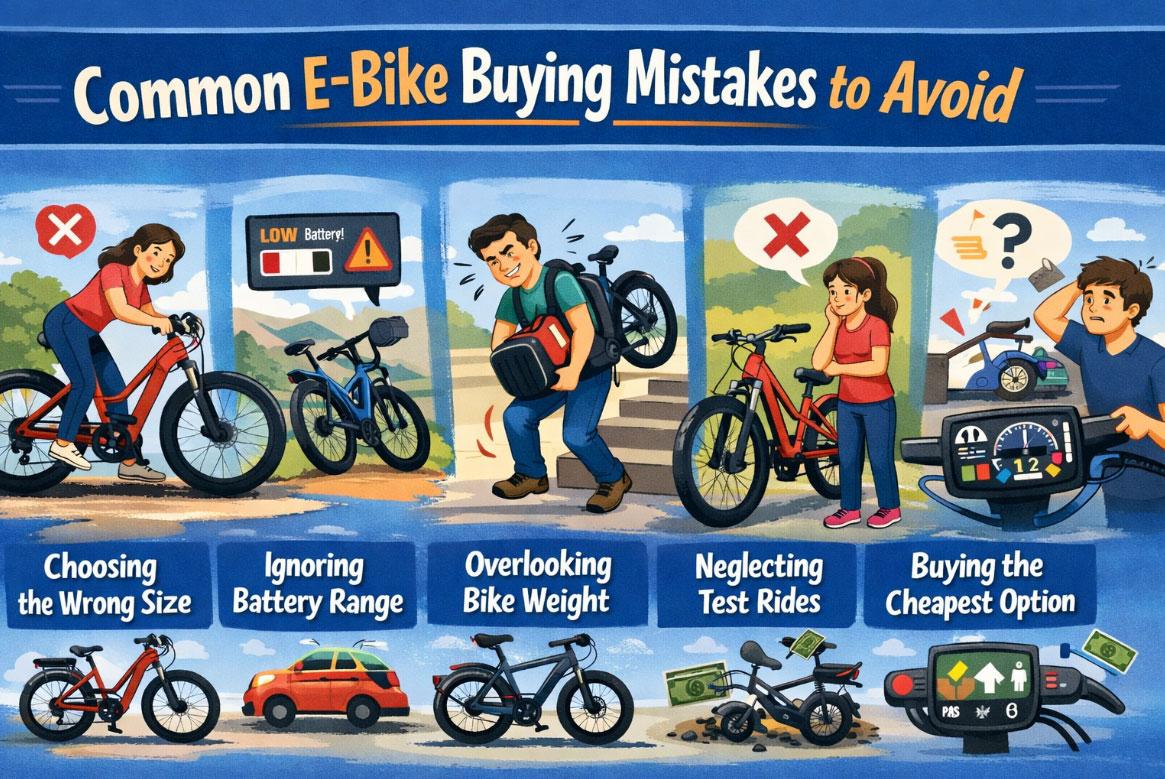
Weight is the spec that beginners overlook and experienced riders obsess over. An e-bike's weight affects almost everything: how it rides without motor assistance, how easy it is to carry up stairs or load into a car, how it handles at speed, and how quickly the battery drains.
The Hidden Consequences of a Heavy Bike
Budget e-bikes frequently tip the scales at 25–30kg. At that weight, if your battery dies mid-commute, you're pedaling a bicycle that feels like a refrigerator. If you live in a third-floor apartment with no elevator, you'll be carrying that refrigerator up and down stairs every day. If you need to lift it onto a bike rack, you'll be doing so with a bike heavier than most entry-level motorcycles.
Weight also affects the bike's feel in corners, its braking distance, and the strain on components like brakes and tires. A heavier bike requires more aggressive stopping, which means brake pads and rotors wear faster.
Mid-range bikes often land between 20–24kg, and premium lightweight models (usually carbon or high-grade aluminum) can come in under 16kg — but at significant cost. The question isn't "how light can I afford" but "how heavy is too heavy for my actual life."
What to do instead: Think through your entire use scenario, not just the riding part. Where does the bike live? Do you carry it anywhere? Does it need to fit in a car? Honest answers to these questions will tell you whether a 28kg cargo beast is workable or a daily nightmare.
Mistake #4 — Buying Online Without a Test Ride
The e-bike market has normalized online purchasing in a way that would be unthinkable for any other vehicle. Nobody buys a car without sitting in it first, but people routinely spend $1,500–$4,000 on an e-bike based on YouTube reviews and spec sheets alone.
What a Test Ride Actually Reveals
An e-bike's ride quality is deeply personal. The geometry affects how upright or aggressive your riding position is — and this matters immensely for comfort on longer rides. The throttle response, the way the pedal-assist engages, the feedback through the handlebars, the feel of the brakes: none of this translates through a video or a spec sheet.
Motor tuning particularly varies between brands in ways that are hard to describe and easy to feel. Some motors engage immediately and sharply when you start pedaling; others have a noticeable lag. Some have a natural, almost invisible assist feel; others feel mechanical and intrusive. This isn't about quality — it's about preference, and you can only discover your preference by riding.
What to do instead: Visit a local e-bike dealer before committing. Even if you end up buying online for price reasons, a test ride will give you a reference point. Many bike shops now carry demo models specifically for test rides, and some offer demo programs where you can rent a bike for a day.
Mistake #5 — Underestimating the Importance of Brakes
This one isn't just about money — it's about safety. E-bikes are heavier than regular bicycles and travel faster, often reaching speeds of 25–45 km/h (15–28 mph) depending on classification. At those speeds and weights, your brakes are doing substantially more work than on a standard bicycle. Budget-level brakes on a heavy, fast e-bike are a genuinely dangerous combination.
Mechanical vs. Hydraulic Disc Brakes
Most quality e-bikes above the budget tier now come with hydraulic disc brakes, and for good reason. Hydraulic systems provide more consistent stopping power, require less hand force to actuate, and self-adjust as brake pads wear. Mechanical disc brakes are cable-operated, require more hand pressure, and need more frequent manual adjustment.
The distinction becomes critical in wet conditions, on descents, and in emergency stops. If you're riding in a city with traffic, in variable weather, or at higher speeds, hydraulic brakes are not a luxury — they're a sensible safety investment.
Many cheaper e-bikes ship with mechanical disc brakes, or worse, rim brakes, which perform poorly in wet conditions and are entirely inadequate for heavier e-bike weights.
What to do instead: Make hydraulic disc brakes a near non-negotiable on any bike you'll ride in traffic or at significant speeds. It is one of the specifications that directly correlates with rider safety, not just ride quality.
Mistake #6 — Getting the Wrong Class for Your Intended Use
In the United States, e-bikes are classified into three categories. Class 1 provides pedal-assist up to 20 mph with no throttle. Class 2 provides pedal-assist and throttle up to 20 mph. Class 3 provides pedal-assist up to 28 mph, usually with no throttle (though some states allow throttles on Class 3). Similar classification systems exist in Europe and other markets with their own speed and power limits.
Why This Classification Matters More Than People Think
Choosing the wrong class creates problems that can't be solved after purchase. Many bike paths, national parks, and shared trails prohibit Class 2 and Class 3 bikes. If you plan to use multi-use trails regularly, a Class 1 bike may be the only legal option. Conversely, if you're commuting on roads with traffic and want to keep up with the flow, a Class 1 or 2 bike topping out at 20 mph may feel underpowered compared to a Class 3.
Beyond regulations, there are insurance implications in some regions, registration requirements in others, and helmet laws that vary by class. Buying a Class 3 bike in a state or municipality that effectively prohibits them from bike lanes puts you in an awkward legal position from day one.
What to do instead: Research your local regulations before choosing a class, not after. Check your city's rules on bike path access and whether the routes you intend to ride permit the class you're considering.
Mistake #7 — Skimping on After-Sales Support
This is arguably the most underappreciated factor in the entire buying decision, and it's the one that bites buyers hardest 12 months after purchase.
The E-Bike Support Problem
E-bikes are mechanical and electrical systems with more potential failure points than a standard bicycle. Motors can malfunction. Battery management systems can develop faults. Display units fail. Wiring corrodes. Sensors misfire. When something goes wrong with a bicycle from a reputable brand with a local dealer network, you take it in and they fix it. When something goes wrong with a direct-to-consumer budget brand from overseas, you may find yourself waiting weeks for a replacement part from a company that doesn't have English-language phone support.
Several large-volume online e-bike brands have gone out of business in the last three years, leaving their customers with bikes that have proprietary battery formats and no replacement parts available anywhere. This isn't a hypothetical scenario — it has already happened to tens of thousands of buyers who thought they were getting a great deal.
What to do instead: Before buying, research the brand's customer service reputation specifically, not just the product reviews. Check Reddit communities, look for owner forums, and verify that replacement parts (especially batteries) are available and reasonably priced. A brand with a local dealer network or domestic service centers is worth a price premium.
Mistake #8 — Buying the Wrong Style of Bike for Your Actual Riding
The e-bike market has fragmented into a dizzying array of categories: commuter bikes, cargo bikes, mountain bikes, folding bikes, fat-tire bikes, step-through bikes, cruisers. Each is optimized for a different purpose, and none of them does everything well.
The Mismatch Problem
The most common mismatch is buying a mountain-style or fat-tire e-bike because it looks rugged and capable, then using it exclusively on paved bike paths and city streets. Fat-tire bikes have significant rolling resistance on pavement, which means the motor works harder and battery range shrinks. They're heavier, typically handle less nimbly in urban environments, and the visual aesthetic — which clearly appealed to the buyer — comes with practical trade-offs that affect daily usability.
The opposite mismatch also happens: a lightweight commuter bike purchased by someone who later discovers they actually want to ride gravel roads on weekends, or needs to carry grocery bags, or has a particularly hilly route that demands a mid-drive motor they didn't think to specify.
What to do instead: Spend genuine time mapping out your real use case. What percentage of your riding will be on pavement versus off-road? Do you need cargo capacity? Is your route flat or hilly? How far do you actually ride versus how far you think you'll ride? The bike that fits your honest answers will serve you far better than the one that fits your aspirational ones.
Mistake #9 — Neglecting the True Cost of Ownership
The sticker price of an e-bike is a starting point, not a total cost. Buyers who treat it as the finish line tend to be unpleasantly surprised within the first year.
What You're Not Budgeting For
Tires on e-bikes wear faster than on standard bicycles due to the added weight and motor assistance encouraging higher speeds. Quality e-bike-specific tires run $40–$80 each and should be replaced every 2,000–4,000 km depending on conditions. Brake pads on hydraulic systems cost less per set but require professional bleeding if the system loses pressure — typically $50–$100 at a bike shop. Chain wear is accelerated on e-bikes, particularly those with mid-drive motors, because the motor torque running through the drivetrain degrades the chain faster than human power alone.
Then there's the battery. E-bike batteries typically retain 80% of their original capacity after 500–700 charge cycles, depending on quality and care. A replacement battery from a reputable brand costs $300–$600. Some third-party batteries are cheaper; many are significantly lower quality and carry genuine safety risks (lithium battery fires are a documented hazard with unregulated cells).
What to do instead: Build a realistic annual maintenance budget before you buy. A mid-range e-bike ridden regularly requires roughly $150–$300 per year in maintenance costs, more if you commute year-round in harsh weather. Factor this into your total cost calculation, not just the purchase price.
Mistake #10 — Overlooking Fit and Ergonomics
Cycling injuries from poor fit are extraordinarily common and almost entirely preventable. On an e-bike, where riders often spend more time in the saddle (because it's easier and more fun), the consequences of a poorly fitted bike are amplified.
Why Fit Matters More on an E-Bike
The motor assist on an e-bike reduces the aerobic demand of riding but does nothing to reduce the musculoskeletal stress of poor positioning. Knee pain from incorrect saddle height, wrist and shoulder pain from a too-long or too-short reach to the handlebars, neck pain from an overly aggressive forward position — these accumulate over time and can turn an otherwise excellent bike into something you dread riding.
Step-through frames (which allow mounting without swinging a leg over a high top tube) are not exclusively for older riders or shorter people — they're a genuinely sensible design for urban commuting, making stop-and-go riding easier. High-rise handlebars that promote a more upright posture significantly reduce strain on the lower back for riders who don't need a performance position.
What to do instead: Have your riding position assessed, even informally. Many local bike shops will do a basic fit check when you test ride or purchase. Adjust saddle height before your first ride rather than after you've developed a problem. Pay attention to where your weight sits when riding — too much on the wrists or too little pressure on the saddle are both signals that something needs adjustment.
Final Thought — The Right Ebike is Worth the Research
None of this is meant to make buying an e-bike feel overwhelming. The opposite is true. An e-bike that genuinely fits your needs, your body, your budget, and your riding environment is one of the most transformative purchases a person can make. Former car commuters discover they enjoy their daily route. Cyclists who had aged out of tough hills find themselves climbing again. Families replace second cars. People who never exercised find a form of movement they love.
The stakes are worth understanding because the reward is real. The mistakes outlined here aren't exotic edge cases — they're the same errors that repeat across thousands of forum posts, Reddit threads, and bike shop service desks every single year.
Do the homework. Test ride at least two different bikes. Understand the specs that matter. Research the brand's support infrastructure. And buy the bike that fits your actual life — not the one that fits the version of your life you wish you had.
That's the bike you'll still be riding two years from now.