You bought the eBike. You figured out the app, learned the assist levels, found your preferred route. And then someone mentioned — almost as an afterthought — that the helmet laws for electric bikes are completely different from regular bicycle rules. That the lights you thought were optional are actually required in most jurisdictions after dark. That the mirror law varies not just by country but by state, province, and sometimes by municipality.
Welcome to one of the most fragmented, inconsistently enforced, and genuinely important regulatory corners of the modern cycling world.
Electric bike helmet legislation sits at the uncomfortable intersection of old road traffic law (written before eBikes existed), evolving municipal policy (written by committees who often disagree on what an eBike even is), and genuine public safety concern. The result is a patchwork of rules that confuses experienced cyclists, intimidates newcomers, and occasionally lands riders in legal trouble they never saw coming.
This guide cuts through the confusion. It covers helmet laws by major region, explains the classification system that underpins most legal distinctions, and makes an honest case for the protective gear that goes beyond minimum legal requirements — because on a vehicle that can sustain 28mph on a flat road, "technically legal" and "adequately protected" are not always the same thing.
Understanding eBike Classifications First
Before any helmet law makes sense, you need to understand how most jurisdictions classify electric bikes. The three-tier system — originating in the United States but now influential in regulatory frameworks worldwide — divides eBikes by their speed capability and motor activation method.
Class 1 eBikes provide pedal-assist only, with the motor cutting out at 20mph (32km/h). The rider must be pedaling for the motor to engage. No throttle.
Class 2 eBikes also top out at 20mph but include a throttle — meaning the motor can propel the bike without pedaling input, much like a moped.
Class 3 eBikes provide pedal-assist up to 28mph (45km/h). No throttle is permitted in the standard definition, though some jurisdictions define Class 3 differently.
Why does this matter for helmet laws? Because in the majority of jurisdictions that have updated their eBike legislation, helmet requirements differ across these classes. A Class 1 eBike is often treated identically to a conventional bicycle under the law — meaning helmet requirements mirror whatever that state or country demands of regular cyclists. A Class 3 eBike, capable of sustained speeds that rival a light moped, frequently triggers mandatory helmet laws that apply to all riders regardless of age.
The classification system isn't universal. The EU uses its own framework under the EN 15194 standard, separating "EPAC" (Electrically Power Assisted Cycle, motor up to 250W, assist cutting out at 25km/h) from speed pedelecs (up to 45km/h), which are treated more like motor vehicles. The UK has similar rules. Australia's framework differs again. Understanding which category your bike falls into is the foundational step before interpreting any specific law.
Helmet Laws by Region: The Honest Breakdown
United States
The United States has no federal eBike helmet law. Helmet requirements are entirely determined at the state level, and sometimes at the county or city level on top of that — which creates a situation where crossing a state line can change your legal obligations mid-ride.
As of 2025, the general pattern in US states that have adopted the three-class system breaks down roughly as follows. For Class 1 and Class 2 bikes, mandatory helmet laws typically apply only to riders under 18, mirroring standard bicycle helmet legislation. For Class 3 bikes, many states require helmets for all riders regardless of age.
California, the state with the most eBike riders and arguably the most developed eBike legislation, mandates helmets for all Class 3 riders and for all riders under 18 on any class of eBike. New York treats Class 3 eBikes similarly to mopeds in several jurisdictions, triggering stricter helmet requirements. Texas and Florida have minimal statewide eBike helmet laws, relying on local ordinances and leaving significant regulatory gaps.
The practical advice for US riders: look up your specific state's current eBike legislation, then check your county and city rules, because the local overlay frequently matters. The People for Bikes organization maintains an updated state-by-state tracker that's worth bookmarking.
European Union
EU regulations create a cleaner two-category split. Standard EPACs — the bikes that dominate the European eBike market, with 250W motors and 25km/h assist cutoffs — are legally treated as bicycles. Helmet laws for these bikes follow whatever each member state's bicycle helmet legislation dictates, which ranges from mandatory for all ages (Czech Republic, Slovenia) to mandatory for under-18s (Germany, France, Italy, Spain) to entirely voluntary for adults (Netherlands, Belgium, Denmark).
Speed pedelecs — the faster category capable of 45km/h — face a completely different regulatory picture. In most EU member states, speed pedelecs require registration, insurance, and mandatory helmet use for all riders. In Germany, Belgium, and the Netherlands, approved helmets for speed pedelecs must meet either motorcycle or moped helmet standards, not just bicycle helmet standards. This is a meaningful distinction: a bicycle helmet is engineered for impact speeds up to roughly 20km/h; a speed pedelec rider hitting a car at 45km/h is in a fundamentally different energy regime.
United Kingdom
Post-Brexit, the UK maintains regulations broadly aligned with the pre-Brexit EU framework. Electrically Assisted Pedal Cycles (EAPCs) — the UK's equivalent of EPACs — are treated as bicycles, with no mandatory adult helmet law. Anything that doesn't meet EAPC criteria (motor over 250W, assists beyond 15.5mph/25km/h, or has a throttle that works without pedaling) is classified as a motor vehicle and requires registration, insurance, and a helmet meeting at minimum ECE 22.06 motorcycle standards.
The throttle question catches many UK riders off guard. An eBike with a twist throttle that propels the bike without pedaling — even if its maximum speed is identical to a legal EAPC — does not qualify as an EAPC under UK law. Riding it on public roads without registration and motorcycle equipment is technically illegal, regardless of whether it's been marketed as a bicycle.
Australia and New Zealand
Australia applies a comparatively straightforward approach: helmets are mandatory for all bicycle riders of all ages across all states and territories. Since standard eBikes (up to 250W, assist to 25km/h) are classified as bicycles, this mandatory requirement applies universally. Australia has among the highest bicycle helmet compliance rates in the world, partly because enforcement is routine and fines are real.
Speed pedelecs above the 25km/h threshold require motorcycle registration and licensing in most Australian states, along with corresponding protective equipment requirements.
New Zealand follows a similar framework, with universal mandatory helmet legislation for cyclists including eBike riders.
Canada
Canada's eBike regulatory picture is provincial, much like the US state-level patchwork. Ontario, British Columbia, and Quebec each have distinct rules on classification, speed limits, and helmet requirements. Ontario mandates helmets for all eBike riders under 18; adult riders face varying requirements depending on how the specific eBike is classified. British Columbia requires helmets for all cyclists of all ages, which includes eBike riders. Quebec's rules are more permissive for adults on standard assist bikes.
Beyond the Minimum: What Your Helmet Actually Needs to Do
Meeting the legal minimum on helmet standards and being adequately protected for eBike riding are related but distinct goals. This is worth dwelling on, because the marketing around bicycle helmets frequently obscures a critical engineering reality.
The Speed Problem with Standard Bicycle Helmet Ratings
Most bicycle helmets sold globally are tested to CPSC (US), EN 1078 (EU), or AS/NZS 2063 (Australia/NZ) standards. These standards involve impact tests at speeds corresponding to roughly 20km/h — appropriate for a conventional bicycle rider falling from height onto pavement.
A Class 3 eBike rider traveling at 28mph (45km/h) carries significantly more kinetic energy. In a collision, the head impact speed can be substantially higher than the scenario these helmet standards test for. This doesn't mean a standard bicycle helmet provides no protection at a higher speed — it provides meaningful protection — but it means the protection margin is narrower than the same helmet would provide for a conventional cyclist.
Helmet standards have been evolving to address this. The Virginia Tech MIPS ratings system, which evaluates helmets on real-world impact scenarios including rotational forces, provides a more useful performance indicator than pass/fail certification status. For Class 3 and speed pedelec riders, helmets rated for mountain biking or urban/commuter use with extended rear coverage and reinforced shells offer meaningfully better protection than road cycling lids.
MIPS: The Technology That Actually Matters
Multi-directional Impact Protection System (MIPS) technology — which allows the helmet's inner liner to rotate slightly independently of the outer shell during an oblique impact — has moved from premium feature to expected standard in quality eBike helmets. The physics behind it are well-established: the majority of real-world head impacts in cycling involve rotational forces, not purely linear ones, and MIPS significantly reduces rotational energy transmission to the brain.
For any eBike rider buying a new helmet in 2025, MIPS (or equivalent rotational protection technologies like WaveCel, Koroyd, or SPIN) should be a baseline requirement, not a luxury. The price premium over non-MIPS equivalents has narrowed to the point where the cost-benefit argument is essentially unanswerable.
Helmet Fit: The Variable Nobody Talks About
A perfectly engineered helmet worn incorrectly provides substantially less protection than a basic helmet worn correctly. Fit is the variable that separates theoretical protection from actual protection, and it's depressingly underemphasized in retail environments.
The two-finger rule for strap positioning — two fingers between the chin strap and chin when buckled, straps meeting in a V below each ear — is the starting point, not the entire protocol. The helmet should sit level on the head (not tilted back, as many casual riders wear theirs), should not shift when you shake your head vigorously, and should cover the forehead to within two finger-widths of the eyebrows.
A helmet that passes these checks on initial purchase but has adjustment dials backed off to maximum or minimum stops is the wrong size. Buy the correct size. The protection geometry is designed around proper fit, not compensated by adjustment systems.
Lighting: What the Law Requires and What You Actually Need
The Legal Baseline
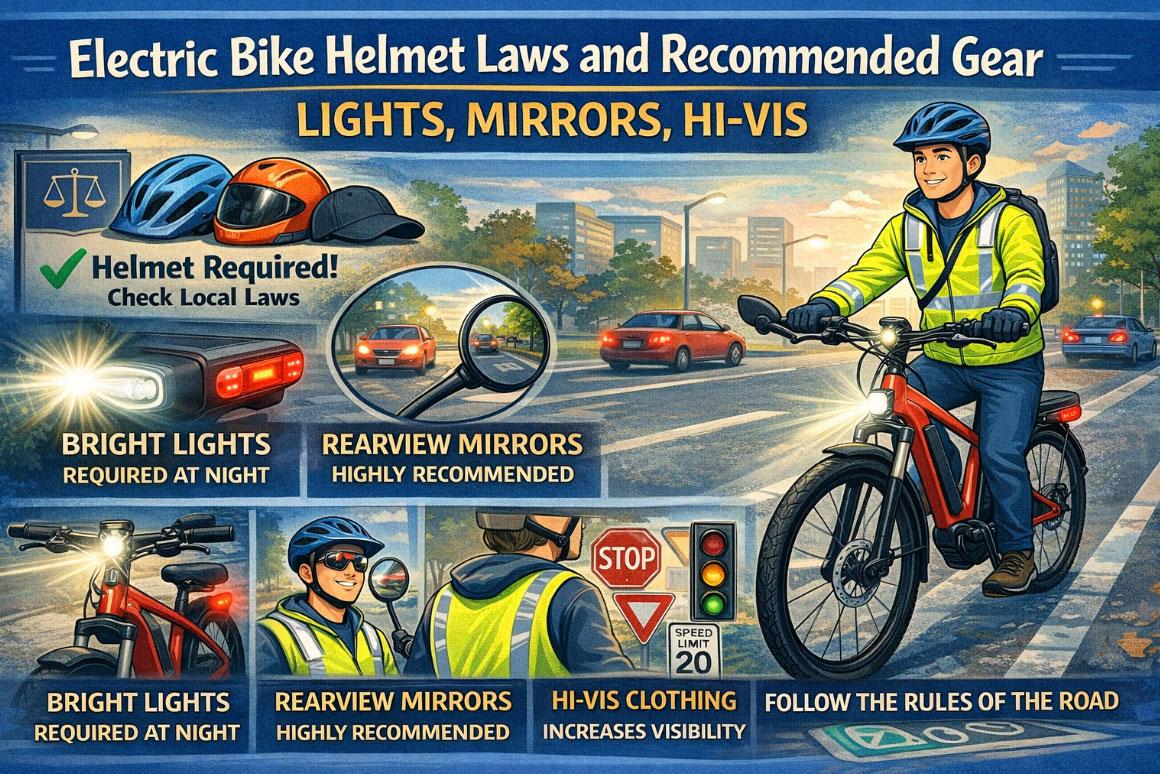
Most jurisdictions that require bicycle lighting specify a white or amber front light visible from a defined distance (typically 500 feet/150 meters) and a red rear light or reflector. The specifics vary: some require lights to be illuminated continuously while others permit flashing modes; some specify minimum lumen outputs while others rely only on visibility distance criteria.
For eBike riders, the lighting laws that apply to bicycles generally apply — unless the eBike is classified as a moped or motor vehicle in your jurisdiction, in which case motor vehicle lighting standards (which are considerably more demanding) kick in.
The practical reality is that minimum-legal lighting and adequate-for-safety lighting are not the same thing. A 20-lumen rear flasher technically satisfies many jurisdictions' legal requirements. It is not the same as being seen by a distracted driver at 200 meters in wet, overcast conditions.
Front Lighting: The Lumen Reality
For urban riding on lit roads, a front light in the 200–400 lumen range provides adequate visibility and reasonable see-by illumination at eBike speeds. For unlit roads or trails, serious eBike commuters should look at 600–1,000+ lumen units, particularly given the higher speeds at which Class 3 bikes travel.
The beam pattern matters as much as raw lumen output. Road-optimized eBike lights use a shaped beam — wide and flat to illuminate the road surface ahead without blinding oncoming riders or drivers. Many bicycle lights use a circular beam optimized for the rider's visibility rather than for illuminating the path ahead. If you're riding at 25mph on an unlit road, you need to actually see what's coming; a 500-lumen circular beam is less effective for this than a 300-lumen road-optimized beam from a quality manufacturer.
Exposure, Lezyne, Lupine, and Busch & Müller (whose StVZO-approved lights are engineered specifically for road-legal eBike use) are among the brands worth looking at for this use case. StVZO approval — the German road traffic standard — is a useful quality indicator even for riders outside Germany, as it requires a proper shaped beam and real-world performance validation.
Rear Lighting: Being Seen from Behind
Rear lighting for eBikes has evolved considerably. The old standard — a single red flasher bolted to the seatpost — remains common and legally sufficient in most jurisdictions. But it represents a significant underinvestment in rear visibility for a vehicle traveling at speeds where a rear-end collision from a vehicle is a genuine risk.
Daytime running lights — rear lights bright enough to be visible in full daylight, typically 50–200 lumens in solid or pulse mode — have become standard equipment on quality eBike builds and are a worthwhile addition for commuters who ride in variable conditions. Research on daytime visibility consistently shows that even in daylight, active lights dramatically improve other road users' ability to perceive a cyclist's presence and distance.
Integrated tail lights built into the seatpost, rear fender, or cargo rack are increasingly available on eBike-specific designs and offer aerodynamic and aesthetic advantages over bolt-on accessories. For riders whose eBikes receive regular rain exposure, these integrated units also tend to be more durably weatherproofed than accessory lights.
Visibility While Stopped: The Overlooked Gap
Most eBike lighting discussion focuses on moving visibility. A frequently overlooked scenario is the stopped or slow-moving rider — at an intersection, in traffic, or pulling over to check directions. At these moments, the rider's body provides minimal dynamic visual cues to following traffic.
Spoke lights, wheel-mounted LED strips, and frame-integrated lighting all contribute to 360-degree visibility that makes a stationary eBike rider dramatically more conspicuous than lights alone. For urban commuters in heavy traffic, this additional peripheral visibility isn't paranoia — it's a rational response to how driver attention actually works.
Mirrors: The Safety Accessory the Industry Undervalues
The cycling world has a complicated relationship with mirrors. Road cyclists dismiss them as aesthetically incompatible with serious riding. Mountain bikers don't need them. But eBike commuters — riding at sustained higher speeds in traffic, often carrying cargo or wearing a full-face helmet that limits peripheral vision — occupy exactly the use case where mirrors provide the highest safety return on investment.
The Case for Mirrors on eBikes
At 28mph, a Class 3 eBike is traveling fast enough that shoulder checking — momentarily turning your head to assess traffic — creates meaningful handling uncertainty, particularly for newer riders or those on less stable cargo configurations. A mirror allows continuous awareness of following traffic without disrupting forward attention or bike control.
The objection that mirrors reduce aerodynamic efficiency is technically valid and practically irrelevant for commuter eBike riders. The objection that they break easily is a product selection issue, not an inherent limitation of the technology.
Bar-end mirrors (mounted at the handlebar ends) offer the widest field of view and best integration into handlebar aesthetics. Helmet-mounted mirrors, popular with touring cyclists, move with the rider's head for intuitive use but require adjustment whenever the helmet shifts. Stem-mounted and frame-mounted mirrors are less common but suit specific cockpit configurations.
Busch & Müller, Ergotec, and Hafny produce eBike-appropriate mirrors with sufficient build quality to survive daily commuter use. Glass mirror elements provide dramatically better image clarity than polished aluminum alternatives and are worth the premium for regular use.
High-Visibility Gear: Making the Investment That Matters
The Science of Being Seen
The physics of human visual perception are not sympathetic to cyclists. A rider wearing dark clothing against a dark road surface presents minimal contrast to a driver's visual system, particularly in the peripheral vision range where most driving hazard detection actually occurs. The human eye is not reliably scanning the full visual field ahead; it's pattern-matching against expected hazards, and an eBike-sized object in dark clothing can fail to trigger that pattern-matching until dangerously late.
High-visibility clothing works through two mechanisms. Fluorescent materials — the yellow-green (chartreuse) and orange that characterize safety vests — absorb UV light and re-emit it as visible light, making the wearer appear to glow in daylight and low-light conditions. Retroreflective materials bounce headlight beams directly back to the driver, making the wearer dramatically more conspicuous at night.
These mechanisms work differently and complement each other. A fluorescent vest is most effective in daylight and overcast conditions; it provides minimal benefit at night. Retroreflective tape or panels are most effective when a light source is directed at them; they're near-invisible in flat ambient lighting.
For maximum all-condition visibility, eBike commuters should look for gear that combines both: fluorescent base material with retroreflective panels or binding. This is the combination specified for professional road workers and emergency services for exactly this reason.
Jacket and Vest Options
The dedicated cycling hi-vis market has improved substantially in the last five years. Early high-visibility cycling gear was overwhelmingly designed for utility rather than comfort or weather performance — essentially road worker vests with reflective tape applied over whatever fit the budget.
Current offerings from brands like Proviz, Altura, Showers Pass, and Rapha include fully waterproof hi-vis jackets with structured fits, moisture-wicking liners, ventilation zoning, and retroreflective panels that cover 50–70% of the garment's surface area. These aren't compromises between visibility and usability — they're genuinely good cycling jackets that happen to maximize your chance of being seen.
For riders resistant to the visibility vest aesthetic, the market has also produced understated options: dark base garments with extensive retroreflective detailing that appears subtle in daylight but blazes white under headlights. Commuters who want to look professional at their destination without changing can find workwear-adjacent options with this engineering approach.
Gloves: Visibility and Protection Combined
Cycling gloves occupy a dual role that's underappreciated in safety discussions. They protect the palmar surface in the instinctive hands-out fall response — one of the most common cycling injury mechanisms — while also providing an opportunity for signaling visibility.
Hi-vis gloves with retroreflective palm panels maximize the visibility of hand signals, which is the one moment a rider's hand is most critically seen by following and oncoming traffic. This is a small detail with a disproportionate safety return, particularly for eBike riders whose higher speeds make signal misinterpretation more consequential.
Shoes and Lower Body Visibility
Lower body visibility is frequently neglected in cycling safety gear discussions. The feet are, perversely, one of the most visible parts of a cyclist to oncoming drivers — the rotating motion of pedaling creates peripheral movement that the visual system detects better than static objects. Retroreflective heel tabs, ankle bands, or cycling shoes with reflective detailing capitalize on this dynamic visibility in a way that static torso lighting cannot.
Ankle bands with retroreflective material are among the cheapest and most effective visibility accessories available. Several manufacturers produce dedicated cycling versions; industrial safety tape applied to regular ankle-height socks achieves functionally similar results at negligible cost.
Building Your Complete eBike Safety Setup: A Practical Guide
Translating all of the above into a purchasing decision requires calibrating to your specific riding context — the speed class of your bike, your riding environment, your typical conditions, and your budget. Here's a framework for working through that calibration systematically.
Step one: Establish your legal baseline. Look up the specific laws for your jurisdiction, including both state/national and local levels. Know which helmet standard is required for your bike class, which lighting configuration is legally mandated, and whether your eBike's classification triggers any motor-vehicle-level requirements.
Step two: Assess your actual risk environment. A Class 1 rider doing 10-mile urban commutes in a city with dedicated protected bike lanes has a different risk profile from a Class 3 rider doing 20-mile mixed road routes in low-light conditions with significant vehicle traffic. Your gear investment should scale with the risk, not just the legal minimum.
Step three: Prioritize by impact. Helmet quality and fit are the highest-leverage safety investment — prioritize getting these right over spending money on accessories. Rear visibility is the second priority for most urban commuters, given that rear-end collisions represent the incident type most influenced by passive visibility gear. Front lighting quality matters most for riders on unlit routes at speed.
Step four: Integrate, don't accessorize. A helmet with integrated rear lighting, an eBike with integrated front and rear lights, and clothing with built-in reflective detailing is more reliable (and more likely to be used consistently) than a collection of clip-on accessories that get forgotten, lost, or left uncharged. When purchasing either a new eBike or new safety gear, favor integrated solutions.
Conclusion: The Gear You Wear Is the Argument You Make
Every eBike rider who shows up at work or at the school gate wearing a well-fitted helmet, with functioning lights and reflective details visible from 100 meters, is making an argument. Not a preachy, self-righteous argument — just a quiet, practical one. That electric bikes are a serious transportation choice made by serious people who've thought about the risks and responded proportionally.
The helmet law landscape will continue to evolve as eBikes proliferate and as the speed and power capabilities of the technology push legislators toward clearer frameworks. But the law has always been a floor, not a ceiling. The ceiling is set by the quality of your gear, the honesty of your risk assessment, and the discipline you bring to the routine — because the ride that hurts you is always the one you weren't quite prepared for.
Get the helmet right. Get the lights right. Get the visibility right. Ride longer, ride more, and arrive intact. The rest of the eBike revolution is considerably more enjoyable from that foundation.