There's a particular kind of dread that hits an eBike rider somewhere around mile 28. The battery indicator drops from two bars to one, the motor assist softens to a whisper, and the hills that felt effortless an hour ago suddenly remember they exist. Range anxiety — that creeping psychological tax on every electric vehicle owner — has long been eBiking's most stubborn limitation.
But 2025 and the horizon ahead look different. Battery chemistry is evolving faster than most casual observers realize, charging infrastructure is catching up to the ambition of the hardware, and a new generation of eBike-specific energy systems is making "run out of juice" a phrase riders will soon use only in nostalgia.
This isn't just incremental progress. The gap between a 2019 eBike battery and what's shipping today — and what's being prototyped for 2026 — is roughly the same distance as the gap between a flip phone and a smartphone. The underlying physics hasn't changed, but engineers have gotten dramatically smarter about working around it.
How We Got Here: A Brief History of eBike Battery Evolution
To understand where the technology is going, it helps to know what it's escaping from.
Early eBike batteries — the kind bolted awkwardly to rear racks in the early 2010s — were almost comically limited. Lead-acid packs weighing 10 to 15 pounds delivered 200 to 300 watt-hours (Wh) of usable energy and degraded to 70% capacity within 200 charge cycles. They were heavy, slow to charge, and prone to dying spectacularly in cold weather.
The lithium-ion revolution changed the game. By the mid-2010s, cylindrical 18650 cells — the same format used in laptop batteries and, famously, early Tesla vehicles — became the eBike standard. Ranges crept upward. Weight dropped. The 400Wh pack became the new baseline for a "good" commuter eBike.
But lithium-ion brought its own constraints. Energy density plateaued around 250–270 Wh/kg at the cell level. Charging speeds were throttled by thermal concerns — push too much current through a lithium-ion cell too fast, and it heats up, degrades, and eventually becomes a fire risk. The chemistry was revolutionary for its era and has now run into the ceiling of what incremental improvement can achieve.
That ceiling is where today's engineers are doing their most interesting work.
The New Battery Chemistries Changing Everything
Lithium Iron Phosphate (LFP): The Quiet Workhorse
If you've purchased an eBike from a major brand in the last two years, there's a reasonable chance it uses a lithium iron phosphate (LFP) cell, whether the spec sheet says so or not. LFP isn't new — the chemistry was first commercialized in the late 1990s — but the manufacturing improvements of the last five years have made it genuinely competitive with traditional nickel manganese cobalt (NMC) cells that dominated the mid-2010s.
The tradeoffs are worth understanding. LFP cells offer slightly lower energy density than NMC — roughly 150–200 Wh/kg versus 200–270 Wh/kg — meaning an LFP pack of the same physical size will carry less energy. But the advantages are significant: LFP cells tolerate faster charging with less heat generation, they have dramatically longer cycle lives (often 2,000–3,000 cycles before notable degradation versus 500–1,000 for NMC), and they're considerably safer due to a more thermally stable chemistry that resists the "thermal runaway" phenomenon responsible for lithium battery fires.
For the everyday eBike commuter who charges every night, LFP's longevity advantage is essentially worth a free battery replacement over a five-year ownership window. The energy density gap shrinks when you factor in that LFP packs can be safely discharged to a deeper state without accelerating wear.
Semi-Solid and Solid-State: The Next Leap
The conversation about solid-state batteries has been "five years away" for roughly fifteen years. But something has shifted. Semi-solid state batteries — a transitional chemistry that replaces the liquid electrolyte with a gel or semi-solid material while keeping some conventional cell architecture — are now shipping in limited commercial quantities, and several eBike-focused manufacturers have announced integration timelines for 2025 and 2026.
The significance is hard to overstate. Semi-solid cells offer energy densities in the 350–500 Wh/kg range, a step-change improvement over conventional lithium chemistries. They also dramatically reduce thermal risk, since the flammable liquid electrolyte is largely eliminated. Early prototypes suggest charging rates of 4C or higher (meaning a full charge in 15 minutes or less) without meaningful cycle life penalty.
Fully solid-state batteries — using a solid ceramic or polymer electrolyte — remain further out for consumer eBike applications, but the intermediate semi-solid technology represents a commercially realistic bridge that could hit mainstream eBike pricing within two to three years.
Silicon Anode Technology: Squeezing More from Existing Chemistry
A less dramatic but more immediately impactful upgrade involves swapping the graphite anode in conventional lithium-ion cells for a silicon-enhanced equivalent. Silicon can theoretically hold ten times more lithium ions than graphite, translating directly into higher energy density.
The engineering challenge has always been that silicon expands significantly when charged (by up to 300%), causing structural degradation. But silicon-carbon composite anodes — which blend small amounts of silicon into the graphite matrix — have solved enough of this problem to reach commercial viability. Several eBike battery manufacturers now use cells with 5–15% silicon content in the anode, yielding 15–25% energy density improvements over pure-graphite equivalents at minimal cost premium.
This is the kind of improvement that doesn't make headlines but shows up when the bike you bought with a rated 60-mile range actually delivers 70.
Bigger Packs, Smarter Packs: The Architecture Revolution
Chemistry is only half the story. How cells are packaged, monitored, and managed matters enormously for both performance and longevity.
The 1000Wh Threshold
For years, 625–750Wh represented the top tier of eBike battery capacity. These packs were large, heavy, and expensive, but they enabled 80–100+ mile ranges on pedal-assist modes that actually assist rather than simply whisper encouragement.
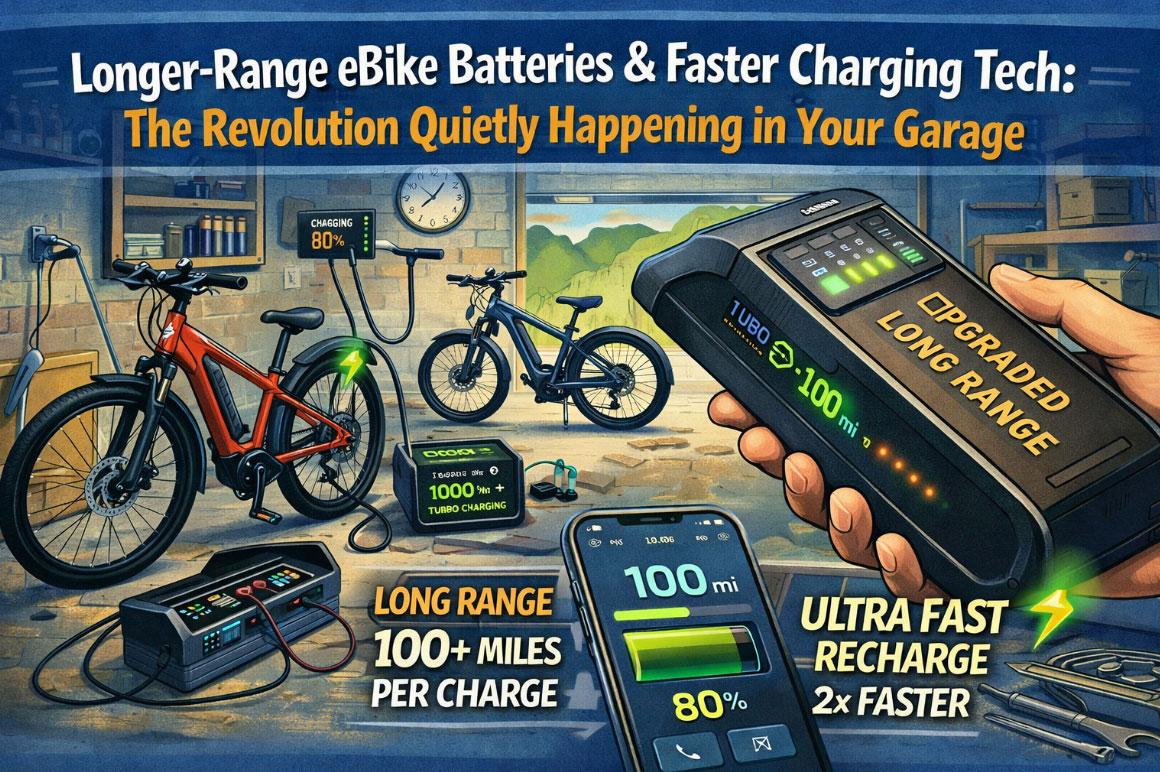
The 1,000Wh barrier has now been crossed by multiple manufacturers. Riese & Müller's dual-battery systems, specialized cargo eBike platforms, and a growing number of adventure/touring-focused builds are routinely shipping with 1,000–1,250Wh of onboard capacity. At conservative pedal-assist settings on flat terrain, these bikes can deliver 150+ miles of range — enough to make range anxiety feel like a problem from another era.
The weight penalty is real: a 1,000Wh pack adds roughly 3–4kg compared to a 500Wh equivalent. But for cargo eBikes or long-distance touring builds where range is the primary requirement, this is an entirely acceptable compromise.
Dual Battery Systems and Hot-Swap Architecture
One of the more elegant engineering solutions to range limitation doesn't involve breakthrough chemistry at all — it involves modularity. Hot-swap battery systems, popularized by brands like Specialized with their swappable Turbo battery architecture and various cargo eBike manufacturers, allow riders to carry a second battery and exchange it without tools in under a minute.
The concept sounds simple, but the engineering is non-trivial. The battery management system (BMS) needs to handle the transition seamlessly, the connectors need to be robust enough to survive thousands of cycles without degradation, and the software needs to accurately track state-of-charge across two separate packs simultaneously.
When it works well — and it increasingly does — hot-swap architecture effectively doubles range without doubling the battery's weight or cost footprint, since the second pack can be left at home for 90% of rides and only brought along when genuinely needed.
Intelligent Battery Management Systems
The BMS has evolved from a basic protection circuit into a sophisticated piece of software engineering. Modern eBike BMS units perform real-time cell balancing (ensuring no individual cell drifts out of alignment with its neighbors), predictive thermal management, adaptive charging curve optimization, and increasingly, machine learning-informed range prediction that accounts for rider weight, terrain, temperature, and riding style.
Some premium systems now communicate bidirectionally with the charger, dynamically negotiating charging rates based on current battery temperature, cell health, and desired charge completion time. This isn't convenience theater — intelligent charging protocols measurably extend cycle life by avoiding the thermal and electrochemical stress of fixed-rate fast charging.
Faster Charging: The Other Half of the Freedom Equation
Range and charging speed are two sides of the same coin. A 100-mile range battery is only as useful as its ability to be replenished within a reasonable time window.
Where the Industry Stands Today
Standard eBike chargers deliver 2–4A of current, resulting in charge times of 4–8 hours for mid-to-large packs. This is entirely adequate for overnight home charging — plug in, go to sleep, wake up to a full battery — but creates friction for any use case involving mid-day top-ups or multi-leg touring rides.
The emerging standard for "fast" eBike charging is 6–10A, cutting charge times to 1.5–3 hours. A growing number of eBike manufacturers are now shipping 6A chargers as standard equipment rather than optional accessories, and aftermarket 8A chargers have become widely available for popular battery formats.
At the premium end, 10A+ fast chargers — capable of taking a 625Wh pack from 20% to 80% in under an hour — are shipping with certain high-end models and as dealer-fitted accessories. This is the automotive industry's equivalent of 100kW DC fast charging, scaled to the very different thermal constraints of a bicycle-sized battery pack.
The CAN Bus Revolution in Charging Communication
One of the quietly significant developments in eBike charging technology is the adoption of CAN bus communication protocols between charger and battery. CAN bus — the same communication standard used in automotive applications — allows the charger and BMS to exchange real-time data during the charging session, enabling dynamic current adjustment rather than fixed-rate charging.
In practice, this means a smart charger can begin a session at maximum current, then taper intelligently as cells approach full charge, without the conservative built-in safety margins that make "dumb" fast chargers either slow or damaging. Bosch's Smart System, Shimano's EP8 platform, and Specialized's Mission Control ecosystem all use variants of this approach, and the real-world results are measurably better: faster effective charge times, lower peak temperatures, and extended cycle life compared to fixed-rate alternatives.
Wireless Charging and Inductive Pads
Wireless charging for eBikes is not yet commercially mainstream, but it's closer than most riders realize. Several European manufacturers have demonstrated functional inductive charging systems embedded in parking bays, capable of delivering 500W–1kW to a compatible receiver plate on the underside of a bike frame.
The appeal is obvious for fleet operators — delivery bikes, rental fleets, corporate mobility programs — where requiring riders to plug in introduces friction and risk of connector wear. A parking bay that automatically charges any compatible bike placed on it, no human intervention required, has compelling operational advantages.
Consumer applications will follow fleet deployments, as they typically do. The technical challenges (alignment sensitivity, efficiency losses at 85–92% versus cable charging's 95%+, and the cost of retrofitting parking infrastructure) are real but not insurmountable. Expect wireless charging to appear as a premium option on flagship eBike models within two to three years.
Solar Integration: Not Quite There, But Getting Interesting
Solar charging for eBikes occupies a peculiar position: technically possible, practically limited, but genuinely useful in specific contexts. A high-efficiency flexible solar panel of the size that can be practically integrated into a cargo eBike's footprint or a pannier bag delivers roughly 10–20W of sustained charging power in good conditions.
This is enough to offset 5–10% of a typical day's energy consumption for a moderate commuter — meaningful as a range extender over a full day's parking, but nowhere close to a replacement for grid charging. The real-world value is greatest for touring riders who park in sunlight for hours between legs, and for cargo eBike operators with large flat cargo surfaces available for panel integration.
The economics don't yet pencil out for most riders, but the technology is improving steadily. Perovskite solar cells, which promise higher efficiency at lower cost than conventional silicon panels, could change this calculus significantly within the next five years.
The Charging Infrastructure Question
Individual battery and charger improvements matter enormously, but the broader ecosystem question — where do you charge an eBike when you're not at home? — deserves serious attention.
Public eBike Charging Networks
European cities have been ahead of the curve here. Amsterdam, Copenhagen, and Zurich have deployed municipal eBike charging stations in meaningful numbers, often co-located with bike parking infrastructure. Japan's extensive covered bicycle parking facilities have increasingly incorporated charging points for electric models.
North American infrastructure lags but is catching up, driven partly by e-cargo bike adoption in urban delivery and partly by municipal cycling infrastructure investment. Some EV charging networks have begun deploying eBike-specific charging points alongside car chargers — a practical choice given that eBike chargers require only a standard 120V outlet and a weatherproof enclosure, adding minimal cost to existing installations.
The standardization question looms large here. Unlike the EV world, which has largely (if painfully) converged on a small number of connector standards, eBike charging remains fragmented. Bosch, Shimano, Yamaha, Specialized, Trek, and dozens of smaller brands all use proprietary connectors and voltage profiles. Universal eBike charging requires either an industry-wide standard (which trade bodies are working toward, slowly) or a proliferation of multi-format charging stations (which is the more likely near-term reality).
Charging at Work: The Missing Piece
For commuter eBike adoption to scale meaningfully, workplace charging is arguably more important than public infrastructure. A rider who can reliably charge at both ends of their commute effectively doubles their usable range and eliminates range anxiety entirely.
Some progressive employers have installed eBike charging alongside EV charger installations, recognizing the outsized carbon impact per dollar of infrastructure investment. An eBike charging point costs a fraction of an EV charger to install and serves a vehicle category with arguably better urban transportation outcomes per unit of energy consumed.
The business case for employer-provided eBike charging is strong — it supports staff wellbeing programs, sustainable commuting incentives, and visible sustainability commitments — and the momentum, while uneven, is clearly building.
What to Expect by 2027
Synthesizing the technology trends across battery chemistry, pack architecture, charging hardware, and infrastructure, a plausible near-term picture emerges.
By 2027, a mainstream mid-range eBike — the $2,500–$4,000 category that represents the bulk of the market — will likely ship with a 600–750Wh LFP or silicon-enhanced NMC pack, a 6–8A fast charger as standard, and a BMS sophisticated enough to deliver genuine 80-mile real-world range under typical mixed conditions. Charge time from 20% to 80% will be under 90 minutes for the majority of models.
Premium and performance models will push into semi-solid cell territory, with 800Wh–1,000Wh packs achieving ranges that make triple-digit mileage unremarkable. Fast charging at 10A+ will be table-stakes at this tier, and bidirectional charging (using the eBike battery to power devices or contribute to home energy systems during grid peak hours) will begin to appear as a premium feature.
Public charging infrastructure will have improved materially in urban areas, though interoperability between brands will remain frustratingly incomplete. Workplace charging will be meaningfully more common, driven by employer sustainability commitments and the simple economics of a technology that's cheap to install and well-used.
The Bigger Picture: Why This All Matters
It's worth stepping back from the technical specifics to notice what this trajectory represents.
The fundamental constraint on eBike utility has always been energy. Not the mechanical complexity of the drivetrain, not the reliability of the motor, not the quality of the control systems — all of which have reached a high baseline standard across the industry. The limit has been how much energy you can carry, how reliably you can replenish it, and how long the energy storage system lasts before it needs replacing.
Every advancement described in this piece chips away at that constraint from a different angle. Better cell chemistry increases the energy you can carry. Smarter pack architecture lets you carry it more flexibly. Faster charging reduces the friction of replenishment. Longer cycle life reduces the lifecycle cost and environmental footprint of the energy storage itself.
The cumulative effect is an eBike that, for the first time, begins to feel genuinely competitive with a car for a broad range of transportation use cases — not just the short urban commute where eBikes have always shone, but the 50-mile shopping trip, the multi-day touring route, the grocery run, the school pickup. The range and charging convenience gap between eBike and car, which was vast five years ago, is closing faster than most people realize.
Choosing a Battery System in 2025: What Actually Matters
For riders navigating today's market, the specification sheet can be overwhelming. Here's what to prioritize, in rough order of importance.
Cycle life over raw capacity. A 625Wh battery that delivers 1,500 cycles at 80% capacity is worth more over a five-year ownership window than a 750Wh battery that degrades to 70% capacity in 500 cycles. Ask about cycle life specifications, not just capacity.
BMS quality. The battery management system is the invisible determinant of real-world performance and longevity. Brands that publish detailed BMS specifications, offer over-the-air firmware updates, and provide transparency about thermal management approaches are investing in the parts that matter.
Charger compatibility. Check whether faster chargers are available for the system you're considering, and what they cost. A battery system that's technically capable of fast charging but ships with only a basic 2A charger is hiding its capability behind an accessory paywall.
Battery replacement availability. Proprietary battery formats can leave you stranded if the manufacturer discontinues support. Favor systems with established ecosystems, long manufacturer support commitments, and realistic aftermarket replacement options.
Cold weather performance. Lithium batteries lose capacity in cold temperatures — typically 20–30% at 0°C compared to room temperature performance. If you ride year-round in a cold climate, this matters enormously and should factor into range calculations more than the headline specification.
Conclusion: The Long Ride Ahead
The eBike battery revolution isn't a single dramatic breakthrough. It's a sustained, multi-front improvement across chemistry, architecture, software, and infrastructure that is collectively reshaping what electric bicycles can do and who they can serve.
The rider who bought their first eBike five years ago and found the range barely adequate for their commute will find today's mid-range offerings genuinely transformative. The rider buying their first eBike today is entering a market where the technology has, at last, caught up with the promise.
And the rider who waits another two years? They'll be choosing from systems built on semi-solid cells, charged by intelligent 10A fast chargers in under an hour, managed by software smart enough to extend pack life well beyond a decade. The long ride ahead just got considerably longer — and considerably more interesting.