What Is the KAKIGO Electric Tricycle?
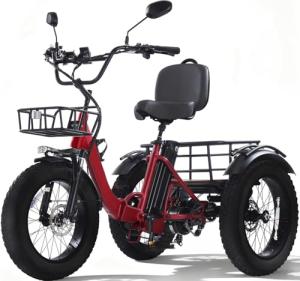
The KAKIGO is a folding, fat-tire, three-wheeled electric bicycle designed for adult riders. It runs on a 48V 15.6Ah removable lithium battery, pairs that with a 850W rear motor with a peak of 1350W and 90 Nm of torque, and rolls on 20" x 4.0" fat tires on aluminum rims. The frame itself folds, making storage and transport genuinely manageable — a feature that sounds like a minor convenience until you're trying to fit a trike into a sedan trunk for a trip to the lake.
It uses a rear differential to allow each rear wheel to rotate at different speeds, improving handling in turns and on uneven surfaces. That differential is not a minor detail — it's one of the most important engineering choices on any three-wheeled vehicle, and the fact that KAKIGO includes it at this price point is notable.
The top speed is governed at 20 MPH, which puts it in the Class 2 e-bike category — legal on most bike paths in the United States without registration.
Who Is This Trike Built For?
The honest answer is that the KAKIGO was designed with a specific rider in mind: someone who values stability over speed, practicality over performance, and comfort over aggression. That's not a criticism — it's a strength.
It's best for seniors, riders with balance concerns, cargo and utility use, and relaxed rides on pavement, gravel, and light off-road paths.
More specifically, consider this trike if you:
- Are returning to cycling after years away from it and don't trust your balance on two wheels
- Live in a community like Sun City, AZ or The Villages, FL and want a practical transportation option for errands
- Regularly carry cargo — groceries, tools, farmers market hauls, dog supplies
- Have mobility limitations or joint pain that makes mounting a standard bike difficult
- Are a caregiver or family member shopping for an older parent who still wants independence and mobility
The low step-through design makes mounting and dismounting easy even for shorter riders or those with limited mobility, and it's generally suitable for heights around 5'2" to 6'2".
That said, this is not a sport trike. If you're a 35-year-old trail shredder looking for an off-road beast, the KAKIGO will likely feel underpowered and too upright for your taste. Know your rider profile before buying.
Motor and Performance — Is 1350W Enough?
The short answer: yes, for what this trike is designed to do.
The 850W rear motor peaks at 1350W with 90 Nm of torque, providing strong performance for hills and city streets. That torque figure matters more than wattage in everyday riding — it's what gets you moving from a stop, what keeps you moving when a hill appears unexpectedly, and what powers you through a headwind on an exposed bike path.
In the real world, riders report that the KAKIGO handles inclines confidently when carrying moderate cargo. You're not going to sprint up a 15% grade like a mountain goat, but you will climb suburban hills and gentle trail slopes without having to dismount and push.
The motor is rear-hub mounted, which combined with the differential creates a notably smooth cornering experience. The innovative rear hub and differential system allows the rear wheels to spin at different speeds, giving the trike superior maneuverability and stability on turns. On a fixed-axle trike, tight turns can feel awkward and even dangerous because both rear wheels are forced to travel the same arc at the same speed. The differential eliminates that problem almost entirely.
The trike supports three riding modes: pure electric (throttle only), pedal-assist with seven adjustable levels, and a walk-assist mode for guiding the trike on foot. The Shimano 7-speed drivetrain adds mechanical versatility — useful for riders who want to get real exercise on flat sections but rely on assist for the tough stuff.
Battery Life and Range — What to Actually Expect
Marketing range figures are almost always optimistic. Here's how to read them honestly.
KAKIGO advertises up to 80–90 miles per charge in optimal pedal-assist conditions, with a realistic range of 50–70 miles for most riders.
The operative phrase there is "most riders." A heavier rider, a hilly route, or consistent use of throttle-only mode will reduce that range significantly. Budget for 40–55 miles in mixed-use real-world conditions and you won't be disappointed.
The 48V 15.6Ah removable battery packs approximately 748.8Wh and is UL2272-certified, with KAKIGO also highlighting compliance with UL2849 e-bike system safety standards. Those certifications are genuinely meaningful — UL2849 specifically covers the entire e-bike electrical system, not just the battery in isolation. For riders who charge indoors or store the trike in an attached garage, this provides real peace of mind.
The battery is mounted centrally within the frame, helping keep the center of gravity low. A keyed lock secures it, and there's a convenient handle for removing and carrying the pack. You can charge it either on the trike or off it — useful for apartment dwellers who store the trike in a garage but want to bring the battery inside.
Charge time is typically 4–6 hours from empty using the included charger. Many riders charge overnight and start every day with a full battery — a habit that essentially eliminates range anxiety for typical use cases.
The Folding Design — Storage and Transport in Real Life
Three-wheeled electric bikes have a reputation for being unwieldy to store and transport. The KAKIGO's folding frame is a direct answer to that complaint.
The fold mechanism allows the trike to reduce its footprint substantially — not to backpack-sized, but enough to fit into a pickup truck bed, a large SUV cargo area, or a dedicated corner of a single-car garage. Apartment riders in cities like Chicago, IL or Portland, OR report being able to wheel the folded trike into an elevator and store it inside their units when necessary.
Assembly from the manufacturer arrives at about 65% pre-assembled, and KAKIGO includes an installation video that most buyers describe as clear and sufficient. Typical first-time setup takes 45–90 minutes. The folding and unfolding mechanism itself becomes quick with practice — most riders report sub-3-minute fold times once they're familiar with the process.
This is a meaningful advantage over non-folding trikes in the same category, many of which require a truck or trailer for transport and a full garage bay for storage.
Comfort, Ergonomics, and the Riding Experience
Electric trikes succeed or fail on comfort, and the KAKIGO makes several smart choices here.
The upright posture and backrest define the riding position — riders used to sporty bikes may need an adjustment period, but for the target audience, the ergonomic seat with back support is a selling point, not a compromise.
The 20" x 4.0" fat tires absorb road imperfections naturally, providing cushion that a narrower tire simply can't match. On cracked asphalt, packed gravel, or light dirt paths, you feel the surface but aren't beaten up by it. Combined with the front suspension fork, the result is a ride quality that's genuinely comfortable for multi-hour excursions.
Seat height extends high enough for taller riders while lowering sufficiently for shorter riders to maintain a comfortable bend in the knee. Seat fore-aft and backrest positions let riders fine-tune distance to the bars and lower-back support. Handlebar angle can usually be rotated slightly to bring the grips closer or further away.
The front and rear baskets are functional highlights that many reviewers specifically call out. The front basket is fixed and sized for a mid-sized bag or several grocery items. The rear basket is larger and positioned low for stability — critical when carrying heavy cargo on a three-wheeled vehicle where top-heavy loads affect handling. A rider heading to a community garden in Sacramento, CA or picking up a weekly CSA box in Austin, TX will find the cargo capacity genuinely practical.
The smart display monitors speed, battery level, and mileage in real time. The interface is straightforward — no app required, no Bluetooth pairing frustrations. Older riders with limited tech comfort consistently appreciate this design choice.
Safety Features — What Keeps You Upright and Stopped
The KAKIGO uses triple hydraulic disc brakes with a parking brake function. This is a significant spec. Hydraulic brakes provide more stopping power with less hand effort compared to mechanical disc brakes, and they self-adjust as pads wear. For riders with limited grip strength — a common concern among seniors — this is not a small detail.
The parking brake is equally practical. On a three-wheeled vehicle that can hold itself upright without a kickstand, a parking brake allows you to stop on a slope, step off, load cargo, and remount without the trike rolling away. It's a feature you don't know you need until the moment you do.
The design includes an IPX5 waterproof rating, meaning light rain and puddle spray won't damage the electronics. This isn't a submersible trike, but it's a real-world-ready one — you won't be stranded if a cloud appears during your morning ride.
Front and rear integrated lights are included, making the trike street-legal and safe for low-light riding. The headlight illuminates adequately for dawn and dusk rides. For night riding in areas without street lighting, supplemental lighting is still advisable.
KAKIGO vs. The Competition — Full Comparison Table
The e-trike market has matured considerably in the past two years. Here's how the KAKIGO compares to the most relevant alternatives available in 2026.
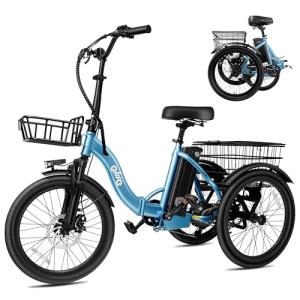
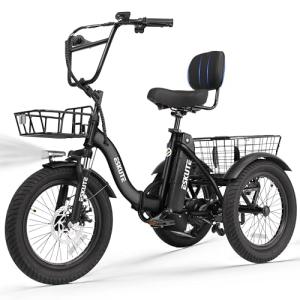
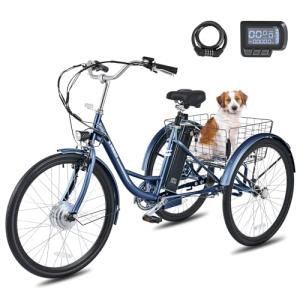
| Feature | KAKIGO 1350W | Skeri 1350W | NARRAK 1350W | ESKUTE E Trike 1200W | Addmotor Landtan 750W |
|---|---|---|---|---|---|
| Peak Motor Power | 1350W | 1350W | 1350W | 1200W | 750W |
| Battery | 48V 15.6Ah (748Wh) | 48V 13Ah (624Wh) | 48V 13Ah (624Wh) | 624Wh | 720Wh |
| Claimed Range (PAS) | 80–90 mi | Up to 80 mi | Up to 50 mi | Up to 55 mi | Up to 65 mi |
| Tire Size | 20" x 4.0" fat | 20" x 4.0" fat | 20" fat | 18" x 3.0" fat | 20" x 4.0" fat |
| Rear Differential | ✅ Yes | ✅ Yes | ✅ Yes | ❌ No | ✅ Yes |
| Brakes | Hydraulic disc (triple) | Hydraulic disc | Hydraulic disc | Disc | Hydraulic disc |
| Folding Frame | ✅ Yes | ✅ Yes | ✅ Yes | ✅ Yes | ❌ No |
| Front & Rear Baskets | ✅ Both | ✅ Both | ✅ Rear only | ❌ Rear only | ✅ Both |
| UL Certification | UL2272 + UL2849 | UL Certified | UL Certified | Not specified | UL Certified |
| Weight Capacity | 440 lbs | Not specified | Not specified | Not specified | 400 lbs |
| Shimano Drivetrain | 7-speed | Not specified | Not specified | Not specified | 7-speed |
| Parking Brake | ✅ Yes | ✅ Yes | Not specified | ❌ No | ✅ Yes |
| Warranty (Motor/Battery) | 6 months | Not specified | Not specified | Not specified | 2 years |
| Available On Amazon | ✅ View Deal | ✅ | ✅ | ✅ | ✅ |
Takeaway from the table: The KAKIGO competes well on battery capacity and cargo versatility. Its combination of both front and rear baskets, triple hydraulic brakes, UL2849 system-level certification, and the larger 15.6Ah battery gives it an edge over the Skeri and NARRAK at similar price points. The Addmotor Landtan is a more premium option with a longer warranty but costs considerably more and doesn't fold.
Where to Buy and What to Expect When It Arrives
The KAKIGO Electric Tricycle is available through Amazon. You can find it at:
Amazon Product Page: https://www.amazon.com/dp/B0G2PTYRG7?tag=ebikeer-20
Amazon Prime shipping makes this accessible to buyers across the continental United States — whether you're in Boise, ID, Nashville, TN, Tampa, FL, or anywhere in between. The package ships in a large box and arrives approximately 65% pre-assembled. You'll need to attach the handlebars, front basket, seat post, and pedals, and perform basic brake and gear adjustments. The included installation video covers all of this, and most mechanically comfortable buyers complete setup solo. If you're not comfortable with any mechanical work, most local bike shops (LBS) will accept e-trike assembly for a typical fee of $50–$100.
Check current pricing and available colors directly on the Amazon listing, as KAKIGO periodically offers discounts and runs promotional pricing across color variants.
Real Talk — The Honest Pros and Cons
What the KAKIGO does well:
- Outstanding battery capacity (15.6Ah) for the price tier
- Rear differential makes cornering genuinely safe and intuitive
- Triple hydraulic disc brakes with parking brake — a genuine safety advantage
- Both front and rear baskets included out of the box
- Folds for storage and transport — a practical edge over many competitors
- UL2272 and UL2849 certified — meaningful safety credentialing
- Supports riders up to 440 lbs — one of the higher weight ratings in this class
- 7-speed Shimano drivetrain adds real riding versatility
Where buyers should temper expectations:
- At approximately 100+ lbs with battery, this is not a lightweight machine — you won't be carrying it up stairs
- The 6-month motor/battery warranty is shorter than some competitors (Skeri offers 24 months on comparable models)
- Top speed is governed at 20 MPH — riders seeking faster performance will need to look elsewhere
- The upright riding position is a comfort choice, not a performance one — aggressive riders may find it too relaxed
- Assembly, while manageable, requires patience and basic mechanical aptitude
Should You Buy the KAKIGO Electric Tricycle?
After thoroughly examining the specs, the comparisons, and real-world rider feedback, the conclusion is clear: the KAKIGO Electric Tricycle earns its place near the top of the mid-range adult e-trike market.
Compared to basic budget e-trikes with 350–500W motors and mechanical brakes, the KAKIGO offers a noticeably stronger motor, larger battery, hydraulic brakes, and better overall build quality. It feels more planted and capable, especially on hills and with heavy cargo. You pay more upfront, but you avoid many of the compromises — weak braking, limited range, underpowered motors — that plague the cheapest options.
For seniors in retirement communities, urban commuters who need cargo capacity, or anyone who's been looking for a stable, practical, and genuinely capable e-bike alternative — the KAKIGO is a serious contender. It's not trying to be the fastest or the most powerful thing on the trail. It's trying to be the most useful, the most reliable, and the most confidence-inspiring three-wheeled electric vehicle you can buy in its class.
On those criteria, it largely succeeds.
👉 Check current pricing and availability: KAKIGO Electric Tricycle on Amazon →